In what ways does your
media product use, develop or challenge forms and conventions of real media
products?
Throughout the opening sequence of these films I noticed many different codes and conventions that were typical of a thriller move. Here is a list of them all an example for each from the four films that show how the conventions are used in real media products:
Conventions of Real Media Thrillers:
 Props: The
props used in the opening sequence of 'Se7en' play a key role in portraying the
characters. Right at the very beginning we see a close-up shot of Somerset
picking up his daily items. These items are laid out very specifically and we
can digest that he is a very organised, precise man that likes things done
properly and seen through to the end. One ideology of this film is that with
age comes wisdom, therefore Somerset's specific ways of doing things, seen in
the order of his props, are the most efficient and safest way of doing them. We
can also assume what his job is as he picks up a gun, which is a very specific
prop for a thriller film as it is unusual it would be featured in a comedy for
example. In relation to Propp's narrative theory, these props help to define
Somerset as the likely hero of the film.
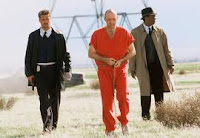
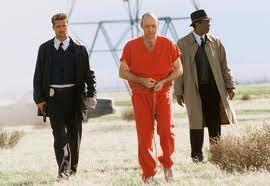
Costume: Somerset and Mills’ costumes are important in portraying their character as well as demonstrating the thriller genre. They both wear very smart clothes with a trench coat so we instantly know their profession, just like we could with the props that were paired with Somerset. Although we don’t see John Doe, later in the film the contrast between the costumes, of the heroes and villain, is very prominent. The colours of their costumes are important too. Mills and Somerset's suits are dark dull colours which contrast greatly with the bright orange of John Doe's costume that appears later in the film. This suggests that he is the one that creates all the drama as orange is a bright, bold, exciting colour which implies that he is the character who holds the authority and who will be centre of the ideas proposed. The dull colours of Somerset and Mills costume also represent mystery and danger, as it does not give too much away but also creates that dark eerie sense of danger associated with men in suits.
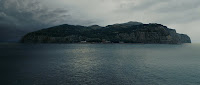
Setting: Thrillers usually take place in isolated, run-down places. Shutter Island is consequently the perfect setting. When the detectives are approaching the island we see that it is completely alone (once again shown by the establishing shot) with no surrounding islands and it is also thick with trees creating the perfect setting for the stock events of a thriller, like getting lost in the woods, being isolated and alone and getting confused as to where you are.
Stock Characters: In all thriller films and any films according to Propp there are universal or stock characters that you would expect to see. Propp devised a narrative theory deeming that in every film there would be these characters:
 The Hero – a character that seeks something
The Villain – who opposes or actively blocks the hero’s quest
The Donor – who provides an object potentially with magical properties
The Dispatcher – who sends the hero on his/her quest via a message
The False Hero – who disrupts the hero’s success by making false claims
The Helper – who aids the hero
The Princess – acts as the reward for the hero and the object of the villain’s plots
Her Father – who acts to reward the hero for his effort
The stock characters in Se7en follow pretty much Propp's theory. John Doe is the criminal/villain and mass murderer. There is more than one victim as Doe kills six people, the seventh being himself. Although, we do not actually see John Doe in the opening sequence or know his 'name' and see his crimes so we know of his existence. In addition Mills and Somerset play the parts of the detectives or people that are going to solve the crime so the audience would expect them to be the heroes. At the end of the film we actually find out that Mills is the false hero as he ends up succumbing to John Doe's plan by killing him.
Stock Events: From my research I found that it is rare to see many if any stock events in the opening sequence of a thriller film. Most start with setting the scene before any action takes place. However, some do go straight into the action before setting the scene, which I find is quite effective as it engages the audience straight from the beginning. 'Cloverfield' and 'Shutter Island' both do not present a stock event in their opening sequences, but the first murder in 'Se7en' can be seen just a few minutes into the film. Murders are very typical events to find in a thriller. They create mystery, tension and fear amongst the audience once again making them feel on edge in addition to a sense of adrenaline. Todorov devised a narrative theory about the structure of the film which can be seen in all three of these films. The reason for a lack of action at the start of the film is explained by this as he suggests they begin with an equilibrium. This equilibrium is then broken in some way (the first murder in the case of 'Se7en') then by the end the equilibrium is restored but it is different to the first. Enigma codes are very common in horror and thriller films and this can be seen in particularly the opening sequence of 'Se7en' in the first murder. The murder brings about many questions for the audience such as 'who did this?' 'why did they do something so violent' 'why did they choose this victim'. This instant disruption to the equilibrium creates the suspense which draws in the audience making them question the film, and enticing them to stay to find out the answers which would be revealed later in the film.
Narrative Theory: Todorov's theory about equilibrium can be applied to the start 'Cloverfield'. At the beginning, everything is as normal, there is an equilibrium, a status quo in the lives of the characters. To carry on with this theory the film must next break the status quo, have people plan to fix it, contain the 'fixing' and then finish with a similar but equal equilibrium. From the brief summary of the film it is evident that at least the next stage will occur and looks to follow this theory to the end. the development of Propp's narrative theory can be seen at the start of Shutter Island. So far the audience have been introduced to Daniels who will play the hero. Aule looks as if he will play the helper, and we know that there is a woman that has escaped who will be the villain. We don't have much more insight into any other of the main character types but it seems as if either the Deputy Warden or the Doctor they speak about could be the father figure. We are yet to find out who the donor, messenger and heroine will be, but so far it supports his theory. Levi-Strauss' theory of conflict and good vs. evil can be seen towards the end of the opening sequence of 'Cloverfield' as the disaster/monster strikes against the city. Here the city is the 'good' against this monster who is the 'bad'. In 'Se7en' Somerset and Mills are 'good' and Doe is the 'bad'. In all films there is some example of good vs. bad even if the line is blurred as conflict between two groups is presented.
Codes of Real Media Thrillers:
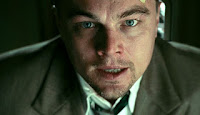 Camera Range: A series of
close-ups are used on Teddy in 'Shutter Island' as he convinces himself not to
be affected by the water. First we see the side of this face looking out the
window then we see his hands getting water from the tap and finally his face.
This all depicts his nervous mood and his expressions of his face in great
detail giving us an idea of how he is feeling presenting the disjointed feel
that the director is attempting to convey. The 'Male Gaze Theory of Representation' can be used as Teddy is presented using relatively close shots of just his face where the emotion and masculinity can be seen. If there were any women in this opening sequence according to the theory their whole body would be shown explicitly to show their femininity perhaps in a provocative way. With Teddy nothing like this is used as the range is close to his face purely showing his aggressive, masculine behaviour.
Camera Angle: The personality and characteristics of Somerset and Mills in 'Se7en' is defined by the camera angles used on them. When we first see Somerset and Mills in the same shot a low camera angle is used. This portrays them both as the strong characters, not weak which would have been implied by using a high camera angle. Throughout the opening sequence
 Somerset and Mills are almost always presented using a low
camera angle so the idea of them being strong and respectable is carried on
throughout this typical thriller opening sequence. Once again this plays in the hands of Propp's narrative theory, helping to define them as the heroes of the film.
Composition: Usually Daniels in 'Shutter Island' is placed in the centre of the shot. When the three men are walking up to one of the hospital buildings he takes up the centre place indicating that he is the main character of the film and that he is also trustworthy and perhaps the hero of the story. Right at the beginning of the film we view him from the view of the mirror as he is looking into it. Once again he in the middle of the shot indicating his role of the hero (again according to Propp's theory of characters) in this thriller film.
Editing: The editing of the opening sequence is very simple and amateur like It uses straight cuts as it replicates the nature of watching back a home-made video, where you have recorded something, stopped recorded and then started recording something else. The director does this to create the sense of the naivety of the characters as they harmlessly record the party not knowing what is about to happen.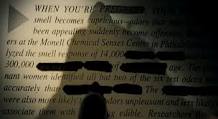
POV: All of the pictures used in the first couple of minutes of 'Se7en' are taken from the point of view of the criminal. It is usual that these pictures will be of obscure angles that represent the corruption and insanity of Doe's mind. As the audience is seeing things from his POV it helps the make them feel uncomfortable and as though they are in the film and that they are the insane man planing the murders of 7 'innocent' people. The director has done this to make them feel consumed in the film, living through the fear and the tension that is created by these primary images.
Music: The only music used in the opening of 'Cloverfield' is at the party, creating the party atmosphere and making it seem like a realistic event, giving the audience the impression that this could happen to any party. The music is very quiet but you can pick it out in the background, and doesn't drown out the dialogue that is taking place, just adding to the atmosphere of the scene.
Sound: As Daniels is walking up to enter the hospital building in 'Shutter Island' he notices a lady patient doing some gardening. As he focusses on her the voice of the marshal drowns out and becomes muffled as all his attention turns to this one lady. The bird and wind can still be heard but everything else is drowned out and a disconcerting ringing sound is apparent, perhaps reflecting the mental state of the woman. This sound creates an unusual effect for the audience, making them feel uneasy and nervous, exactly the type of feeling that the director would want to be created.
Graphics: The main titles of 'Se7en' are very typical of the thriller genre in a number of ways. First and foremost writing of the credits uses a font that is scrawny and not the neatest of fonts. The writing jitters about which could mirror the corruption of John Doe’s mind and show how he
 jumps from one idea for a murder to another. As well
as showing corruption it could imply the repetition and obsessive qualities of
his actions. When the writing in the book is duplicated this could replicate
how obsessive and repetitive he is with his research or his findings and how he
writes everything down that he does, in the same writing so everything looks
the same.
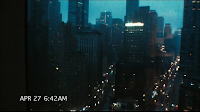
Lighting: The lighting throughout the opening of 'Cloverfield' is very dull. At first just a few lights in the room, provide the light as it is completely dark outside, however there are also lightings from the buildings and cars outside which provide some light too. Being filmed in the early hours of the morning enhances the idea of the city that never sleeps, showing how perfect it is and how through the night it doesn't stop, and implying that nothing can. Which will be tested later in the film as the action occurs. Dim lighting is very typical of thriller films, it creates a sense of tension and mystery making the audience feel on edge and in suspense. The directer of 'Se7en' utilises the lighting very effectively. By and large the lighting placed on all the characters is dark and creates a lot of shadows. This makes the film appear mysterious and creates a feeling of suspense amongst the audience. We don’t really see a character that is properly lit until the scene in the laboratory when Mills, Somerset and the forensic scientist are all lit well. This could indicate that there has been some light shed on the case and that Mills and Somerset now have a clearer view on the case as the audience also has a clearer view physically when watching this scene.
Mise-en-scene: All of the items placed in the shots are there for a reason. The hanging cuffs from the ceiling of the boat in 'Shutter Island' show the nature of Daniels' job and his background. It also foreshadows the cuffs that are around the patients hands and ankles in the hospital. The pictures and the record player in the flashback show the happiness of his previous life as they are the standard homely items that really make a house yours and make it more homely. The flowers in the complex are there to represent the new life that they are trying to create for the patients and also create an ironic twist in that something so beautiful and bright could be in a place where the atmosphere is so morbid.
Ideology: The ideology presented in 'Shutter Island' is that anyone can change and everyone deserves a second chance. The hospital takes patients that can't be kept anywhere else and aims to reform them or at least help them become slightly better.

I took these codes and conventions into much consideration whilst planning my main artefact, below are just some examples of how I took the ideas then used and developed them incorporating them into my own piece.
My Film Use of Conventions:
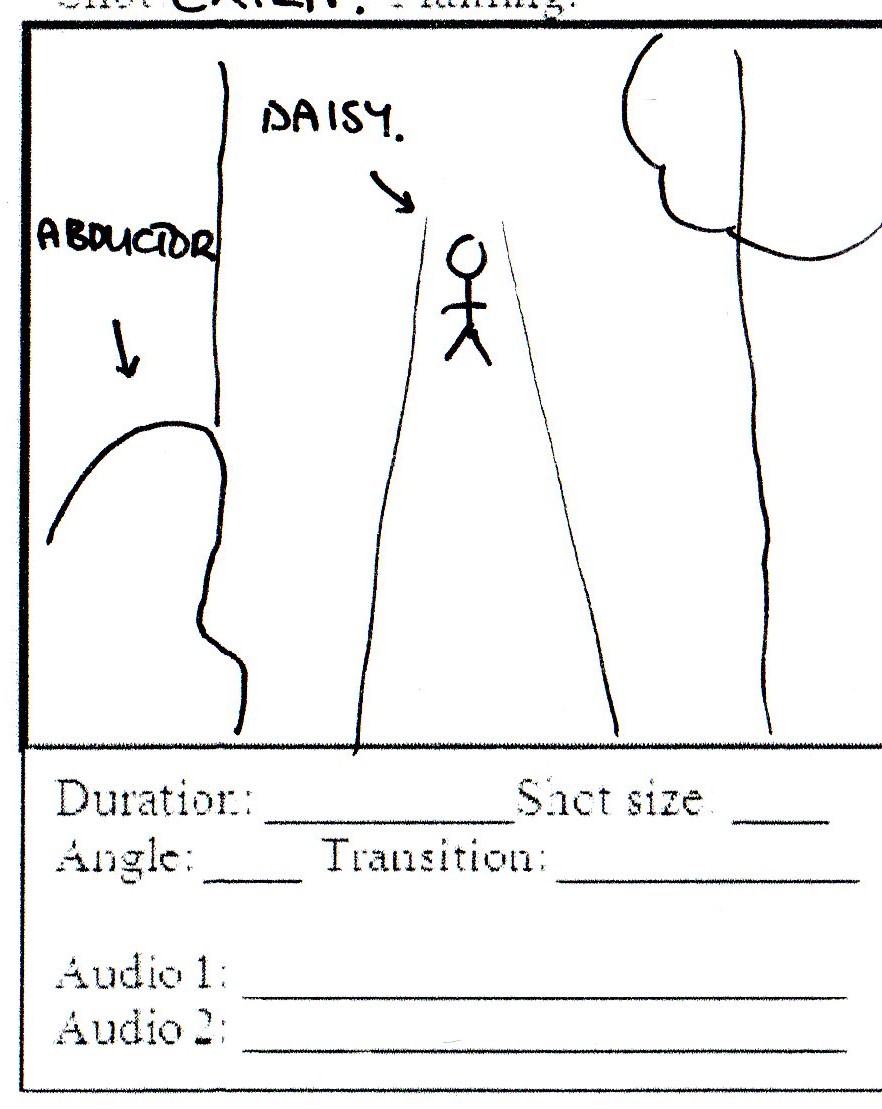
Props: Like in 'Se7en' I used items that would represent my character and indicate which role they would play according to Propp's narrative theory, especially giving the audience a better idea of who the victim was. At the start of my piece, the victim, Daisy starts with a typical, fashionable bag, when she tips everything out of her bag to find her phone the audience sees typical items that would be associated with a teenage girl including a book, lip balm, headphones etc, which also help relate to the social group of teenagers.
Setting: Similar to 'Shutter Island' my thriller took place in a very secluded and quiet area. Woods generally have the connotation of being spooky and full of mystery so I thought this
 would be the perfectly place to shoot my
thriller. I also made sure I shot my sequence on a 'gloomy' day mirroring the weather as the two detectives approached the 'Shutter Island'.
Costume: The costume of my characters represents their role in the film. Daisy is wearing white to portray her innocence along with jeans which indicate that she could be anyone, and this could happen to any individual. The abductor is wearing a black hoody that covers the majority of his face once again creating a sense of mystery as the audience do not know his real identity.
Stock Events: My main stock event in my thriller in the chase of Daisy. This creates tension and suspense as well as exhilaration and excitement. I placed the chase right at the start to get the audience thoroughly engaged straight away into the action of the film. In relation to the enigma code, the chase creates the questions such as 'who is she?' 'why is she being chased' and 'who is chasing her?' this makes the audience involved and engaged as they want to discover the answers to these questions. The chase also symbolises the break in equilibrium that Todorov suggested in his narrative theory about the structure of films.
Stock Characters: The victim is main character of my opening sequence is one of the 8 characters suggested by Propp in his narrative theory. The second character seen in my opening sequence is another in Propp's list is the villain - who abducts the victim, Daisy. It is unclear what role the newsreader, Stewart White, is going to play in the film however, his character could develop to be the helper or perhaps the donor, it is yet to be discovered whether he plays a larger part in the story.
My Film Use of Codes: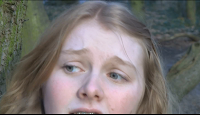
Camera Range: In my thriller I incorporated all sorts of different ranges. In parts there are extreme close-ups that do not allow you to see the bigger picture, but in others I have used mid or long shots revealing slightly more information. The variation between the shots presents a sense of tension as the view for the audience is constantly changing at a fast pace. The close-ups especially really capture the emotion of fear in Daisy's face conveying it to the audience.
Camera Angles: Once again I used a variety of camera angles, including high, low and eye-level. The high angles portray Daisy's innocence and weakness just like the low angle portrayed
 the strong characters of
Somerset and Mills in 'Se7en'. I also used shots that were hand held, and there
for extremely unsteady to help create suspense, tension and fear amongst the
audience. Some shots were also canted to show the unusualness of the
situation. In relation to Propp's narrative theory the high angles aid the audience to realise that Daisy is playing the victim in the film.
Editing: My editing for the chase seen is rather fast paced. This keeps the audience on the edge of their seats as the action plays out. The chase seen that I analysed from 'Lost' used this technique very effectively conveying very much a sense of fear which I have used and developed in my own piece.
Music: The music that I chose for this is upbeat and almost eerie. It supports the quickness of the editing and builds the tension throughout especially when the tempo and volume of the piece increases.
Sound: Whilst background sound in 'Shutter Island' is drowned out to cause effect, the background sound in my film has been enhanced. By doing this the audience is presented with a range of different things needing their attention - the birds tweeting, the footsteps, breathing, music. This combination creates a sense of chaos, and drama which increases the suspense and tension in the piece.
Graphics: The graphics I created for my thriller 'Hostage' were stylised on the graphics of 'Se7en'. I used a rather plain, yet still had an edgy style to them, I also animated them to make them jitter about. Making them similar to those of 'Se7en' increases the authenticity and professionalism of the title sequence.
POV: The majority of the shots I used were from the POV of the abductor or Daisy. The idea that it is changing between the two creates tension amongst the audience as they quickly see the chase developing from the POV of each character. The small insights from the abductor show just how close Daisy is to being caught and how the abductor is normally one step ahead of her as she runs aimlessly through the woods.
Whilst planing, I decided that the aim of my opening sequence would not really challenge the forms and conventions of real media products. I thought that if I defied the normal codes and conventions my thriller would not necessarily be recognisable and also would not appeal to my target audience as in my primary audience research they all indicated that they wanted to see typical codes and conventions of thriller films. However, there is one element that on reflection challenges what I found in my research. This is the use of birds tweeting at the start of the film. The completely contrast between the following chase and the birds, in my opinion creates suspension and uncertainty, yet I do not see this in any of the films I analysed.
In my planning I analysed three thriller films in depth. Firstly, 'Se7en', directed by David Fincher and released in 1995. Secondly, 'Cloverfield' directed by Matt Reeves in 2008 and finally 'Shutter Island' which was directed by Martin Scorsese in 2010. In addition I also analysed small
clip from the TV series 'Lost' which contained a typical thriller movie scene
that was directly related to my own main artefact.
Throughout the opening sequence of these films I noticed many different codes and conventions that were typical of a thriller move. Here is a list of them all an example for each from the four films that show how the conventions are used in real media products:
Conventions of Real Media Thrillers:
 Props: The
props used in the opening sequence of 'Se7en' play a key role in portraying the
characters. Right at the very beginning we see a close-up shot of Somerset
picking up his daily items. These items are laid out very specifically and we
can digest that he is a very organised, precise man that likes things done
properly and seen through to the end. One ideology of this film is that with
age comes wisdom, therefore Somerset's specific ways of doing things, seen in
the order of his props, are the most efficient and safest way of doing them. We
can also assume what his job is as he picks up a gun, which is a very specific
prop for a thriller film as it is unusual it would be featured in a comedy for
example. In relation to Propp's narrative theory, these props help to define
Somerset as the likely hero of the film.
Costume: Somerset and Mills’ costumes are important in portraying their character as well as demonstrating the thriller genre. They both wear very smart clothes with a trench coat so we instantly know their profession, just like we could with the props that were paired with Somerset. Although we don’t see John Doe, later in the film the contrast between the costumes, of the heroes and villain, is very prominent. The colours of their costumes are important too. Mills and Somerset's suits are dark dull colours which contrast greatly with the bright orange of John Doe's costume that appears later in the film. This suggests that he is the one that creates all the drama as orange is a bright, bold, exciting colour which implies that he is the character who holds the authority and who will be centre of the ideas proposed. The dull colours of Somerset and Mills costume also represent mystery and danger, as it does not give too much away but also creates that dark eerie sense of danger associated with men in suits.

Setting: Thrillers usually take place in isolated, run-down places. Shutter Island is consequently the perfect setting. When the detectives are approaching the island we see that it is completely alone (once again shown by the establishing shot) with no surrounding islands and it is also thick with trees creating the perfect setting for the stock events of a thriller, like getting lost in the woods, being isolated and alone and getting confused as to where you are.
Stock Characters: In all thriller films and any films according to Propp there are universal or stock characters that you would expect to see. Propp devised a narrative theory deeming that in every film there would be these characters:
The Hero – a character that seeks somethingThe Villain – who opposes or actively blocks the hero’s quest
The Donor – who provides an object potentially with magical properties
The Dispatcher – who sends the hero on his/her quest via a message
The False Hero – who disrupts the hero’s success by making false claims
The Helper – who aids the hero
The Princess – acts as the reward for the hero and the object of the villain’s plots
Her Father – who acts to reward the hero for his effort
The stock characters in Se7en follow pretty much Propp's theory. John Doe is the criminal/villain and mass murderer. There is more than one victim as Doe kills six people, the seventh being himself. Although, we do not actually see John Doe in the opening sequence or know his 'name' and see his crimes so we know of his existence. In addition Mills and Somerset play the parts of the detectives or people that are going to solve the crime so the audience would expect them to be the heroes. At the end of the film we actually find out that Mills is the false hero as he ends up succumbing to John Doe's plan by killing him.
Stock Events: From my research I found that it is rare to see many if any stock events in the opening sequence of a thriller film. Most start with setting the scene before any action takes place. However, some do go straight into the action before setting the scene, which I find is quite effective as it engages the audience straight from the beginning. 'Cloverfield' and 'Shutter Island' both do not present a stock event in their opening sequences, but the first murder in 'Se7en' can be seen just a few minutes into the film. Murders are very typical events to find in a thriller. They create mystery, tension and fear amongst the audience once again making them feel on edge in addition to a sense of adrenaline. Todorov devised a narrative theory about the structure of the film which can be seen in all three of these films. The reason for a lack of action at the start of the film is explained by this as he suggests they begin with an equilibrium. This equilibrium is then broken in some way (the first murder in the case of 'Se7en') then by the end the equilibrium is restored but it is different to the first. Enigma codes are very common in horror and thriller films and this can be seen in particularly the opening sequence of 'Se7en' in the first murder. The murder brings about many questions for the audience such as 'who did this?' 'why did they do something so violent' 'why did they choose this victim'. This instant disruption to the equilibrium creates the suspense which draws in the audience making them question the film, and enticing them to stay to find out the answers which would be revealed later in the film.
Narrative Theory: Todorov's theory about equilibrium can be applied to the start 'Cloverfield'. At the beginning, everything is as normal, there is an equilibrium, a status quo in the lives of the characters. To carry on with this theory the film must next break the status quo, have people plan to fix it, contain the 'fixing' and then finish with a similar but equal equilibrium. From the brief summary of the film it is evident that at least the next stage will occur and looks to follow this theory to the end. the development of Propp's narrative theory can be seen at the start of Shutter Island. So far the audience have been introduced to Daniels who will play the hero. Aule looks as if he will play the helper, and we know that there is a woman that has escaped who will be the villain. We don't have much more insight into any other of the main character types but it seems as if either the Deputy Warden or the Doctor they speak about could be the father figure. We are yet to find out who the donor, messenger and heroine will be, but so far it supports his theory. Levi-Strauss' theory of conflict and good vs. evil can be seen towards the end of the opening sequence of 'Cloverfield' as the disaster/monster strikes against the city. Here the city is the 'good' against this monster who is the 'bad'. In 'Se7en' Somerset and Mills are 'good' and Doe is the 'bad'. In all films there is some example of good vs. bad even if the line is blurred as conflict between two groups is presented.
Codes of Real Media Thrillers:
 Camera Range: A series of
close-ups are used on Teddy in 'Shutter Island' as he convinces himself not to
be affected by the water. First we see the side of this face looking out the
window then we see his hands getting water from the tap and finally his face.
This all depicts his nervous mood and his expressions of his face in great
detail giving us an idea of how he is feeling presenting the disjointed feel
that the director is attempting to convey. The 'Male Gaze Theory of Representation' can be used as Teddy is presented using relatively close shots of just his face where the emotion and masculinity can be seen. If there were any women in this opening sequence according to the theory their whole body would be shown explicitly to show their femininity perhaps in a provocative way. With Teddy nothing like this is used as the range is close to his face purely showing his aggressive, masculine behaviour.
Camera Angle: The personality and characteristics of Somerset and Mills in 'Se7en' is defined by the camera angles used on them. When we first see Somerset and Mills in the same shot a low camera angle is used. This portrays them both as the strong characters, not weak which would have been implied by using a high camera angle. Throughout the opening sequence

Composition: Usually Daniels in 'Shutter Island' is placed in the centre of the shot. When the three men are walking up to one of the hospital buildings he takes up the centre place indicating that he is the main character of the film and that he is also trustworthy and perhaps the hero of the story. Right at the beginning of the film we view him from the view of the mirror as he is looking into it. Once again he in the middle of the shot indicating his role of the hero (again according to Propp's theory of characters) in this thriller film.
Editing: The editing of the opening sequence is very simple and amateur like It uses straight cuts as it replicates the nature of watching back a home-made video, where you have recorded something, stopped recorded and then started recording something else. The director does this to create the sense of the naivety of the characters as they harmlessly record the party not knowing what is about to happen.
POV: All of the pictures used in the first couple of minutes of 'Se7en' are taken from the point of view of the criminal. It is usual that these pictures will be of obscure angles that represent the corruption and insanity of Doe's mind. As the audience is seeing things from his POV it helps the make them feel uncomfortable and as though they are in the film and that they are the insane man planing the murders of 7 'innocent' people. The director has done this to make them feel consumed in the film, living through the fear and the tension that is created by these primary images.
Music: The only music used in the opening of 'Cloverfield' is at the party, creating the party atmosphere and making it seem like a realistic event, giving the audience the impression that this could happen to any party. The music is very quiet but you can pick it out in the background, and doesn't drown out the dialogue that is taking place, just adding to the atmosphere of the scene.
Sound: As Daniels is walking up to enter the hospital building in 'Shutter Island' he notices a lady patient doing some gardening. As he focusses on her the voice of the marshal drowns out and becomes muffled as all his attention turns to this one lady. The bird and wind can still be heard but everything else is drowned out and a disconcerting ringing sound is apparent, perhaps reflecting the mental state of the woman. This sound creates an unusual effect for the audience, making them feel uneasy and nervous, exactly the type of feeling that the director would want to be created.
Graphics: The main titles of 'Se7en' are very typical of the thriller genre in a number of ways. First and foremost writing of the credits uses a font that is scrawny and not the neatest of fonts. The writing jitters about which could mirror the corruption of John Doe’s mind and show how he


Lighting: The lighting throughout the opening of 'Cloverfield' is very dull. At first just a few lights in the room, provide the light as it is completely dark outside, however there are also lightings from the buildings and cars outside which provide some light too. Being filmed in the early hours of the morning enhances the idea of the city that never sleeps, showing how perfect it is and how through the night it doesn't stop, and implying that nothing can. Which will be tested later in the film as the action occurs. Dim lighting is very typical of thriller films, it creates a sense of tension and mystery making the audience feel on edge and in suspense. The directer of 'Se7en' utilises the lighting very effectively. By and large the lighting placed on all the characters is dark and creates a lot of shadows. This makes the film appear mysterious and creates a feeling of suspense amongst the audience. We don’t really see a character that is properly lit until the scene in the laboratory when Mills, Somerset and the forensic scientist are all lit well. This could indicate that there has been some light shed on the case and that Mills and Somerset now have a clearer view on the case as the audience also has a clearer view physically when watching this scene.
Mise-en-scene: All of the items placed in the shots are there for a reason. The hanging cuffs from the ceiling of the boat in 'Shutter Island' show the nature of Daniels' job and his background. It also foreshadows the cuffs that are around the patients hands and ankles in the hospital. The pictures and the record player in the flashback show the happiness of his previous life as they are the standard homely items that really make a house yours and make it more homely. The flowers in the complex are there to represent the new life that they are trying to create for the patients and also create an ironic twist in that something so beautiful and bright could be in a place where the atmosphere is so morbid.
Ideology: The ideology presented in 'Shutter Island' is that anyone can change and everyone deserves a second chance. The hospital takes patients that can't be kept anywhere else and aims to reform them or at least help them become slightly better.

I took these codes and conventions into much consideration whilst planning my main artefact, below are just some examples of how I took the ideas then used and developed them incorporating them into my own piece.
My Film Use of Conventions:

Props: Like in 'Se7en' I used items that would represent my character and indicate which role they would play according to Propp's narrative theory, especially giving the audience a better idea of who the victim was. At the start of my piece, the victim, Daisy starts with a typical, fashionable bag, when she tips everything out of her bag to find her phone the audience sees typical items that would be associated with a teenage girl including a book, lip balm, headphones etc, which also help relate to the social group of teenagers.
Setting: Similar to 'Shutter Island' my thriller took place in a very secluded and quiet area. Woods generally have the connotation of being spooky and full of mystery so I thought this

Costume: The costume of my characters represents their role in the film. Daisy is wearing white to portray her innocence along with jeans which indicate that she could be anyone, and this could happen to any individual. The abductor is wearing a black hoody that covers the majority of his face once again creating a sense of mystery as the audience do not know his real identity.
Stock Events: My main stock event in my thriller in the chase of Daisy. This creates tension and suspense as well as exhilaration and excitement. I placed the chase right at the start to get the audience thoroughly engaged straight away into the action of the film. In relation to the enigma code, the chase creates the questions such as 'who is she?' 'why is she being chased' and 'who is chasing her?' this makes the audience involved and engaged as they want to discover the answers to these questions. The chase also symbolises the break in equilibrium that Todorov suggested in his narrative theory about the structure of films.
Stock Characters: The victim is main character of my opening sequence is one of the 8 characters suggested by Propp in his narrative theory. The second character seen in my opening sequence is another in Propp's list is the villain - who abducts the victim, Daisy. It is unclear what role the newsreader, Stewart White, is going to play in the film however, his character could develop to be the helper or perhaps the donor, it is yet to be discovered whether he plays a larger part in the story.
My Film Use of Codes:

Camera Range: In my thriller I incorporated all sorts of different ranges. In parts there are extreme close-ups that do not allow you to see the bigger picture, but in others I have used mid or long shots revealing slightly more information. The variation between the shots presents a sense of tension as the view for the audience is constantly changing at a fast pace. The close-ups especially really capture the emotion of fear in Daisy's face conveying it to the audience.
Camera Angles: Once again I used a variety of camera angles, including high, low and eye-level. The high angles portray Daisy's innocence and weakness just like the low angle portrayed

Editing: My editing for the chase seen is rather fast paced. This keeps the audience on the edge of their seats as the action plays out. The chase seen that I analysed from 'Lost' used this technique very effectively conveying very much a sense of fear which I have used and developed in my own piece.
Music: The music that I chose for this is upbeat and almost eerie. It supports the quickness of the editing and builds the tension throughout especially when the tempo and volume of the piece increases.
Sound: Whilst background sound in 'Shutter Island' is drowned out to cause effect, the background sound in my film has been enhanced. By doing this the audience is presented with a range of different things needing their attention - the birds tweeting, the footsteps, breathing, music. This combination creates a sense of chaos, and drama which increases the suspense and tension in the piece.
Graphics: The graphics I created for my thriller 'Hostage' were stylised on the graphics of 'Se7en'. I used a rather plain, yet still had an edgy style to them, I also animated them to make them jitter about. Making them similar to those of 'Se7en' increases the authenticity and professionalism of the title sequence.
POV: The majority of the shots I used were from the POV of the abductor or Daisy. The idea that it is changing between the two creates tension amongst the audience as they quickly see the chase developing from the POV of each character. The small insights from the abductor show just how close Daisy is to being caught and how the abductor is normally one step ahead of her as she runs aimlessly through the woods.
Whilst planing, I decided that the aim of my opening sequence would not really challenge the forms and conventions of real media products. I thought that if I defied the normal codes and conventions my thriller would not necessarily be recognisable and also would not appeal to my target audience as in my primary audience research they all indicated that they wanted to see typical codes and conventions of thriller films. However, there is one element that on reflection challenges what I found in my research. This is the use of birds tweeting at the start of the film. The completely contrast between the following chase and the birds, in my opinion creates suspension and uncertainty, yet I do not see this in any of the films I analysed.